The Artist
Jason Nelson grew up in Oklahoma City, Oklahoma. He earned a BA from the University of Oklahoma and an MFA in New Media Writing from Bowling Green State University. Currently, Nelson is a digital and hypermedia poet and artist. He is a lecturer on Cyberstudies, digital writing and creative practice at Griffith University in Queensland, Australia. Nelson is best known for his artistic flash games/essays such as Game, Game, Game And Again Game and I made This, You Play This, We are Enemies (Wikipedia).
Nelson’s style of Web art is unique, messy, arguably child-like, retro, and provocatively opinionated with his own personal views on the world, politics, consumerism and the environment, just to name a few.
Nelson’s work merges various genres and technologies, focusing on collages of poetry, images, sounds, movements and interactions (Wikipedia).
Since he began work as a hypermedia poet, Nelson has created over 30 digital works of art, including his personal art portal, secrettechnology.com, which won a Webby award for the Weird category in 2009 (Wikipedia).
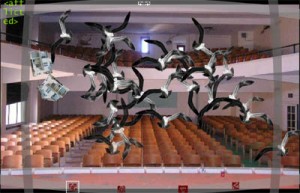
To view Nelson’s Pandemic Rooms click on the image or the following link http://www.secrettechnology.com/pandemicrooms/
The Work
Pandemic Rooms is an interactive piece of net/web artwork created by Jason Nelson that plays off of societal fears and paranoia around contracting a pandemic disease in the form of a flu virus and the ways in which society navigates those fears; both real and imagined. As the viewer interacts with Nelson’s piece, they have the option of viewing the pandemic outbreak from four different vantage points – The Affected, The Emotions, The Pathogen, and The Cleansing. Each of the four viewing platforms contains an additional four options in which the viewer can navigate through the pandemic. Each of the sub-platforms are highly interactive and generative and allow the viewer to click and drag icons to add and subtract to and from the scene, which helps to create music and movement; while other sub-platforms are more passive in the sense that the viewer is simply meant to watch the scene unfold. Even in the passive scenes, where the viewer does not have an interactive role in creating the scene, the viewers are still able to interact with the scene by listening to and watching the pandemic unfold; through story, image and music.
The Critical Analysis
While not a traditionally critical, political or philosophical work of parody or satire, Nelson’s piece does help to bridge the gap between paranoia and reality. Nelson brings awareness to the potential of a pandemic without actually taking the viewer into the heart of the pandemic – all while making the viewer consciously aware of the fact that they are navigating their own fate.
Jason Nelson’s Pandemic Rooms is electronic literature (e-lit) – why, because Nelson’s work meets many of N. Katherine Hayles’ genres of e-lit, including “code, hypertext fiction, interactive fiction and top down approach to narrative in which the narrator spins a story and the bottom-up model of interactivity in which the user chooses how the story will be told” (17). According to Hayles works of e-lit “are deeply penetrated by code” (5) and Nelson’s work while aesthetically quirky and unconventional does use tradition forms of code such as Java Script and Flash, to create the end result of what he likes to call digitial or hypermedia poetry, but what Hayles prefers to simply call e-lit.
When Hayles and her coworkers got together to create the criteria for the first volume of Electronic Literature Volume One (ELC1) they established some very strict criteria as to what would and would not classify as e-lit. If work was to be included into ELC1 the work had to include at least one of the following criterion: “work performed in digital media and work created on a computer but published in print (Hayles 3) and or the committee’s formulation for works to be included in ELC1, was that the piece was “work with an important literacy aspect that [took] advantage of the capabilities and contexts provided by stand-alone or networked computers (Hayles 3). By this definition, Nelson’s Pandemic Rooms and all of his works would classify as e-lit according to Hayles’ definition.
More importantly than Hayles’ genres and definitions of e-lit is her statement that “electronic literature, tests the boundaries of the literally and challenges us (readers) to rethink our assumptions of what literature can do and be” (5). All of Nelson’s works challenge Hayles’ aforementioned statement, and engage his readers into a highly interactive world, where the viewer is allowed to navigate fully the world in which they are interacting; thus becoming a part of the digital poetic that was created.
Any of Jason Nelson’s current and future works of digital poetics should be considered for inclusion into any electronic literature anthology, as Nelson’s creations are fresh, interactive, multi-modal, kinetic and just plan quirky – and it is exactly Nelsons’ quirkiness that allows his audience to interact with and be drawn into the world of e-lit as a whole.
Works Cited
Hayles, N., Katerine. Electronic Literature: New Horizons for the Literary. Notre Dame: University of Notre Dame, 2008. Print.
Wikipedia. Jason Nelson. 24 February 2013. Web. 23 March 2013.