English 335
Electronic Literature E-cyclopedia Entry
Living Will by Mark. C. Marino
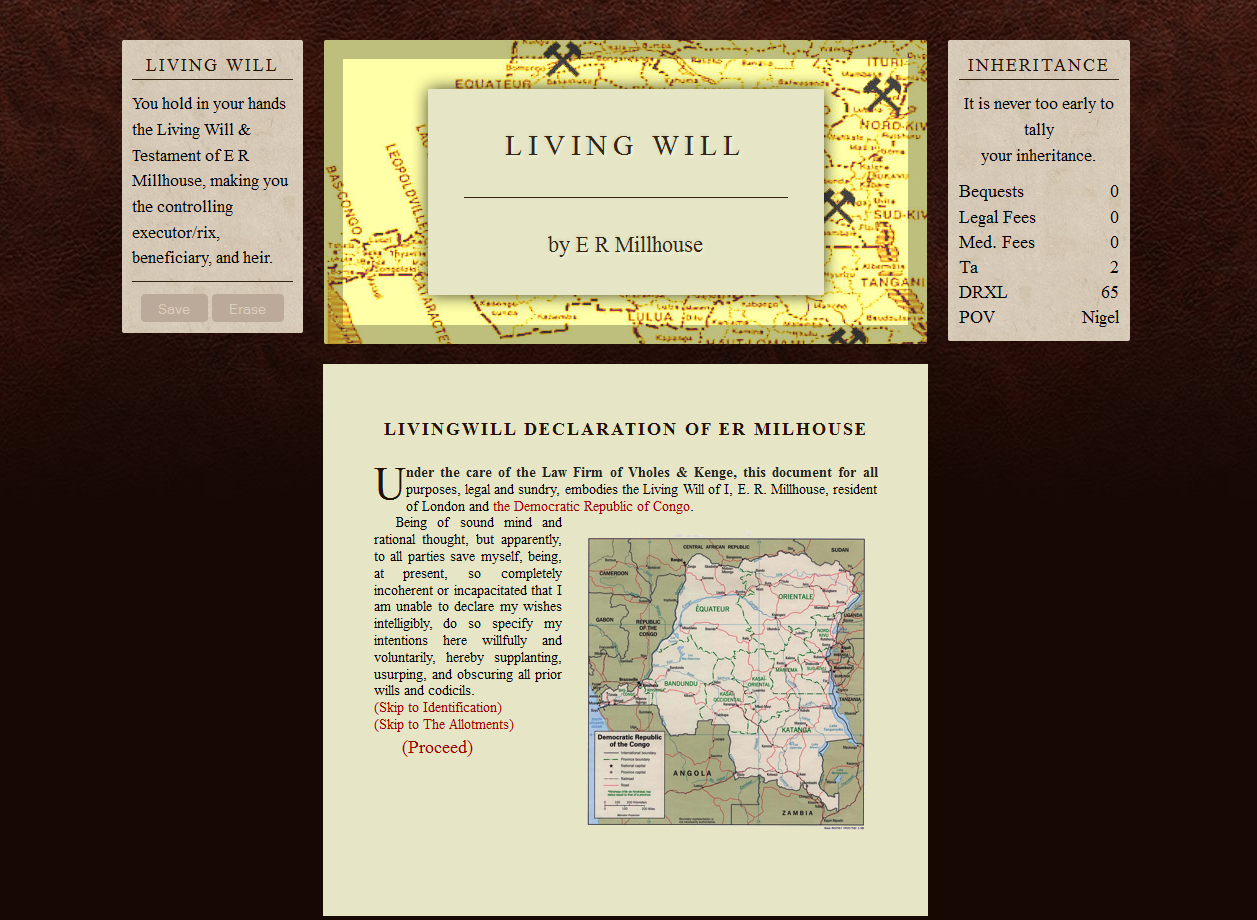
Description:
This piece of electronic literature is a story-game fiction. It is an interactive
experience that uses JavaScript to manipulate the text where the reader gets to
click and choose certain words to move the story forward. The work is presented
as the living will and testament of E.R. Millhouse, and makes the reader act as
the controlling executor, beneficiary, and heir. Each word that the reader clicks
triggers a text command on the screen that influences the direction in which the will
proceeds. The interactivity and participation of the reader is essential to this work
of electronic literature because the story will not go on if the text is not actually
prompted to do so. The sense of game play comes in as the reader will soon realize
that the story can get better or worse depending on which word he or she clicks. The
uncertainty of where the story is going adds mystery and excitement, which makes
the whole reading experience quite interesting.
Commentary:
This work of electronic literature is interesting because it uses electronic
hypertexts, which make it a navigable piece. As N. Katherine Hayles states, “they
present to the user a visual interface that must be navigated through choices the
user makes to progress through the hypertext; and they are encoded on multiple
levels that the user can access using the appropriate software, for example, by
viewing the source code of a network browser as well as the surface text. As a result
of its construction as a navigable space, electronic hypertext is intrinsically more
involved with issues of mapping and navigation than are most print texts” (Hayles,
Print Is Flat, Code Is Deep: The Importance of Media-Specific Analysis”). Living Will
is a perfect example of how electronic literature goes beyond the limits of what
printed text can do. When a reader is presented with a printed book, the number of
pages available can be visibly seen. However, electronic hypertext lets the reader
navigate through a piece of work where there is no clear finish line and this makes
the experience more thrilling. Printed texts enable readers to physically turn back
the pages if they did not like the path they chose. However, electronic stories like
Living Will, leave readers with no choice but to move onwards with the story until it
is finished, regardless of being presented with desirable or undesirable outcomes.
This encourages readers to be more actively engaged in the story as the fate of the
main character is in their hands and there is no option of turning back unless they
choose to restart from the beginning.
Author Biography:
Mark C. Marino is an experienced writer and scholar of electronic literature. He
lives in Los Angeles, California and teaches at the University of Southern California.
Additionally, he is the Director of Communication of the Electronic Literature
Organization and is the editor of Bunk Magazine. He has produced other creative
works of electronic literature, including one he co-authored with nine other people
called 10 PRINT CHR$(205.5+RND(1)); : GOTO 10. Living Will is in the process
of being translated into French for an electronic literature organization called
bleuOrange Revue. His research specialties include electronic literature, computers
and composition, game studies, critical studies, and software studies.
Works Cited
Hayles, N. Katherine. “Print Is Flat, Code Is Deep: The Importance of Media-Specific
Analysis.” Porter Institute for Poetics and Semiotics (2004): p. 83. Web. 21
March 2013.
Marino, Mark C. “Living Will.” Spring Gun Press, 2012. Web. 21 March 2013.
Link: