
Brizzkey’s Review of Facade

I actually used to play this game quite often over a year ago. The animation wasn’t spectacular, in fact the glitches made it quite hilarious, and sometimes it could be a bit frustrating with Trip and Grace not always giving you ample time to respond. Not to mention, that god damn 35 character limit. It should be safe to say that if you’re a master tweeter– which is a SAD, SAD ACCOMPLISHMENT– this game might be easier for you, depending on whether you’re patient enough to wade out it’s run time to actually obtain an ending that isn’t you getting booted out of the house.
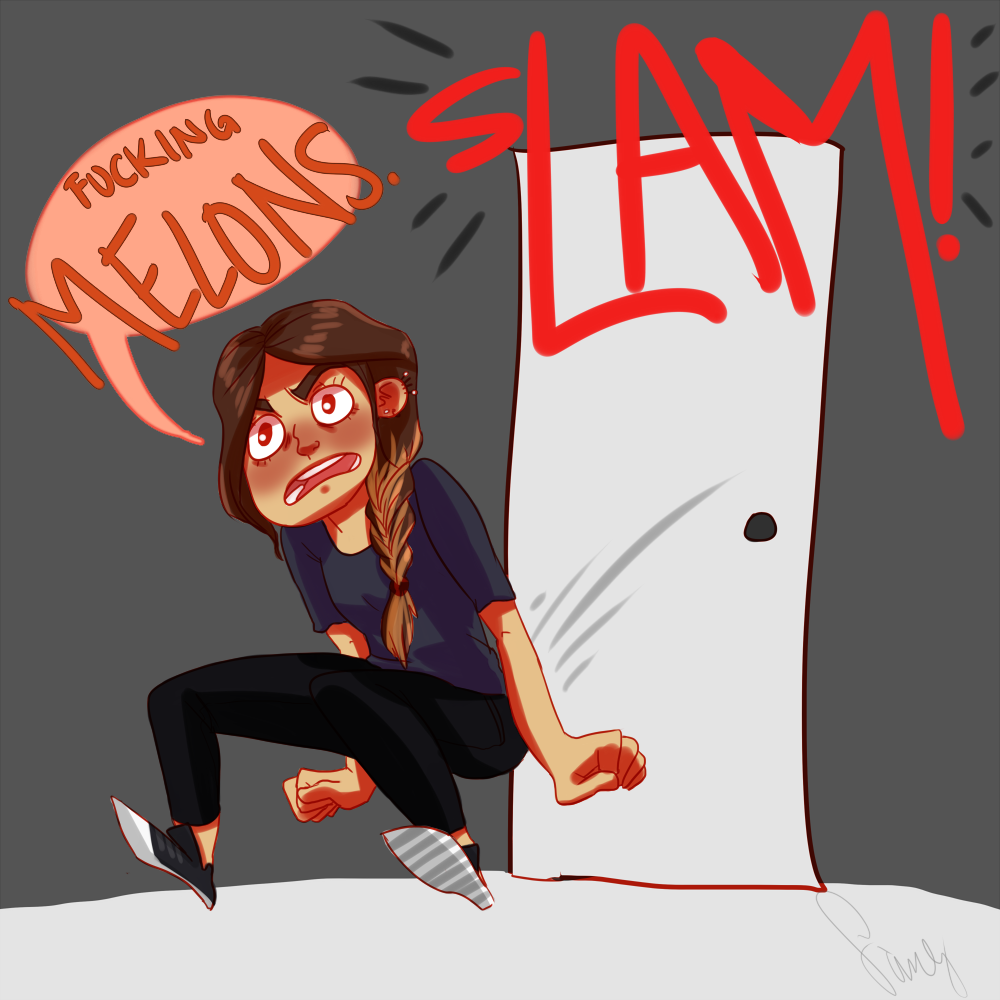
Fun fact #1 about this game: saying the word “melon” gets you automatically kicked out of the apartment.
Fun fact #2: If you leave the apartment, Trip will get upset. He’ll push you back into the apartment, telling you that you have to leave, and then will push you back out the door.
I also enjoy picking up the phone when it rings, and constantly typing “pizza? pizza? pizza?”.
In all seriousness, the characters in this game do have some back story to them if you play it right. On many occasions, the best idea is to stay evenly sided with both characters, as opposed to just one, as it may end up with you getting booted out the door.
**SPOILERS ABOUND, YARGH!**
In most scenarios, I always come across Trip being incredibly materialistic. Why? Because his family had been homeless for a while as a child. It left Trip psychologically damaged in a sense that he never wanted to end up having nothing ever again. You find that he uses these possessions to fill up his life and give him a sense of security. I think this doesn’t just apply to the apartment and furniture though. One could argue that even if Trip might love Grace, his reason for marrying her might have also been heavily influenced by wanting to fill every void in his life. He perhaps desired her more on a materialistic scale than he did on an emotional scale. I would say this is a tragic flaw for Trip. Despite all charity and good-intentions, he’s obsessive and preoccupied with vanity and materialism. He forgets about the emotional aspects, and buys into the consumerist version of romance (i.e. vacation to Italy, proposing in front of Grace’s family, etc).
Grace is always the one more spiteful in the beginning. If anything, she’s always looking for something to disagree with Trip on, while Trip is trying to maintain this façade that they are a happy couple(that falls apart pretty quickly). You find out that Grace is an interior designer who is left unfulfilled by her work. She originally had aimed to be an artist, but was discouraged by Trip, and decided to pursue her current career path. As the argument between the couple become heated, it finally is revealed *drum roll* Grace PAINTED THAT PICTURE ON THE WALL! No, not that terribly depressing wedding photo. That weird, modernist, abstract thing. With the lines. Yeah, that one. Much to Trip’s surprise, she goes on to reveal that she has been painting IN SECRET! *gasp* To be honest, I’m left rather unfulfilled by Grace, as much as she is with her job. Grace’s downfall is that she let people push her down a path of life that she knew she wasn’t going to be happy with: agreeing to marry Trip in front of her parents, becoming an interior designer, there’s probably more that goes here. She didn’t take action when she had to, and now she is deciding to become upset over everything and hold Trip fully responsible, when she really should be holding herself accountable for her own mistakes. She does seem to grow a lot more than Trip during the course of the story, seeing as how in most cases, Grace is the one who leaves the apartment after realizing that she needs to make a change.
The only hopeful ending I’ve really gotten out of this game, is when the two seem to come to an agreement that they both need to talk, and Trip politely escorts you out the door while thanking you.
When it comes down to it, the real tragic element of this game is that even if you want to aid these two in mending their relationship: the chances are that their divorce is inevitable. They’re dysfunctional to the point where they’ve been unable to vocalize some fears or dissatisfaction, sometimes one cheats on the other, and whether they care for one another at all still is overshadowed by the fact that both have clearly fallen out of love. Trip merely keeps deluding himself that there is still romance, whereas Grace is simply more out in the open with her upset.
Brizzkey’s Tragedy Rating: 3 Hamlets out of 10.
Related Posts
-
 A Novel A.I. Game Too Premature –
Posted on Sep 16, 2013
-
 Introduction to Brizzkey
Posted on Sep 12, 2013
Tags
Share This


